The Internet’s Vanity Plates
Wednesday, 02 June 2010 | by Pat's Picks
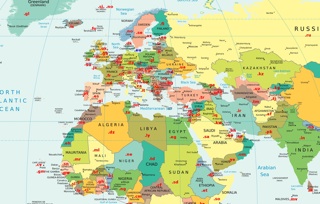
It may be called New York magazine but from the links it posts on Twitter you’d be forgiven for thinking it was based in Antigua and Barbuda. That’s because the magazine uses .ag as a link shortener. By the same logic, readers of Pat’s Papers may think we’re based in Serbia when they see our .rs suffix, but we really we just wanted a quick way to spell out pape.rs.
And we’re not alone. Link shorteners are quickly becoming the vanity plates of the Internet. Many small countries sell the rights to their unique codes to individuals and companies looking to personalize themselves in the sea of information. For example, the Polynesian island of Tuvalu is sitting on a goldmine with its official .tv designation. The provider of my custom link shortening service, bit.ly, went to Libya to get its easy-to-remember address. And Djibouti is reaping in the dividends from its official .dj by marketing itself to disc jockeys.
In the past few months, news organizations large and small have been giving up generic link shorteners like bit.ly and is.gd in favor of their chosen custom link shortener. It’s been a bit of a geography lesson for me. After seeing the New York Times go to nyti.ms I learned that “ms” means Montserrat. Huffington Post’s .to comes from Tonga.
All this makes me wonder if the publishers of the Onion have thought about punctuating their stories with an export from the Bahamas, where .bs is the local designation.
(While we’re on this topic, can anybody explain to me why people are still using tinyURL.com links when trying to conserve characters on Twitter? Seems to me it’s just half a dozen wasted characters when options like ow.ly are out there. I know tinyURL was among the pioneers, but it’s not to “tiny” anymore. Are these the same people who are still using excite.com for their search needs?)

The Internet Assigned Numbers Authority’s official list of designations
Scroll down for Wikipedia’s list of the most popular designations used for vanity or commercial uses:
* .ac is a ccTLD for Ascension Island, but is sometimes used in Sweden, as “AC” is the abbreviation for the V?sterbotten County.[5]
* .ad is a ccTLD for Andorra, but has recently been increasingly used by advertising agencies or classified advertising.
* .ag is a ccTLD for Antigua and Barbuda and is sometimes used for agricultural sites. In Germany, AG (short for Aktiengesellschaft) is appended to the name of a stock-based company, similar to Inc. in USA.
* .am is a ccTLD for Armenia, but is often used for AM radio stations, or for domain hacks (such as .i.am).
* .as is a ccTLD for American Samoa. In Denmark and Norway, AS is appended to the name of a stock-based company, similar to Inc. in USA. In Czech Republic, the joint stock corporation a.s. abbreviation stands for Akciov? společnost.
* .at is a ccTLD for Austria but is used for English words ending in at (e.at).
* .be is a ccTLD for Belgium, but is sometimes used for the literal term “be” and the Swiss Canton of Bern.
* .by is a ccTLD for Belarus, but is sometimes used in Germany, as “BY” is the official abbreviation of the state Bayern.
* .ca is a ccTLD for Canada, and is occasionally used to create domain hacks like histori.ca, the web domain of the Historica/Dominion Institute. This type of use is limited by the .ca domain’s Canadian residence requirements.
* .cc is a ccTLD for Cocos (Keeling) Islands but is used for a wide variety of sites such as community colleges, especially before such institutions were allowed to use .edu.
* .cd is a ccTLD for Democratic Republic of Congo but is used for CD merchants and file sharing sites.
* .ch is a ccTLD for Switzerland but there are also a few church websites.[6]
* .ck is a ccTLD for Cook Islands was notably abused in Chris Morris’s Nathan Barley by preceding it with “.co” in order to spell out the word “cock” (.co.ck as in trashbat.co.ck).
* .co is a ccTLD for Colombia but is marketed as commercial, corporation or company.[4]
* .dj is a ccTLD for Djibouti but is used for CD merchants and disc jockeys.
* .fm is a ccTLD for the Federated States of Micronesia but it is often used for FM radio stations (and even non-FM stations, such as internet radio stations).
* .gg is a ccTLD for Guernsey but it is often used by the gaming and gambling industry, particularly in relation to horse racing and online poker.
* .im is a ccTLD for the Isle of Man but is often used by instant messaging programs and services.
* .in is a ccTLD for India but is widely used in the internet industry.
* .io is a ccTLD for the British Indian Ocean Territory. Notable examples are online storage site Drop.io and task list site Done.io.
* .is is a ccTLD for Iceland but is used as the English verb, “to be” in conjunction with a directory name suffix to complete a linguistically correct sentence.
* .it is a ccTLD for Italy but is used in domain hacks (e.g. .has.it).
* .je is a ccTLD for Jersey but is often used as a diminutive in Dutch (e.g. “huis.je”), as “you” (“zoek.je” = “search you!”), or as “I” in French (e.g. “moi.je”)
* .la is a ccTLD for Laos but is marketed as the TLD for Los Angeles.
* .li is a ccTLD for Liechtenstein but is marketed as the TLD for Long Island.
* .lv is a ccTLD for Latvia but is also used to abbreviate Las Vegas or less frequently, love.
* .ly is a ccTLD for Libya but is also used for words ending with suffix “ly”.
* .md is a ccTLD for Moldova, but is marketed to the medical industry (as in “medical domain” or “medical doctor”).
* .me is a ccTLD for Montenegro, and is recently opened to individuals.
* .mn is a ccTLD for Mongolia, but is used to abbreviate Minnesota.
* .ms is a ccTLD for Montserrat, but is also used by Microsoft for such projects as popfly.ms.
* .mu is a ccTLD for Mauritius, but is used within the music industry.
* .ni is a ccTLD for Nicaragua, but is occasionally adopted by companies from Northern Ireland, particularly to distinguish from the more usual .uk within all parts of the United Kingdom
* .nu is a ccTLD for Niue but marketed as resembling “new” in English and “now” in Scandinavian/Dutch. Also meaning “nude” in French/Portuguese.
* .pr is a ccTLD for Puerto Rico, but can be used in the meaning of “Public Relations”
* .rs is a ccTLD for Serbia but being used as English words ending with the letters “rs” such as www.blogge.rs
* .sc is a ccTLD for Seychelles but is often used as .Source
* .sh is a ccTLD for Saint Helena, but is also sometimes used for entities connected to the German Bundesland of Schleswig-Holstein or the Swiss Canton of Schaffhausen, or to Shanghai or Shenzen in China.
* .si is a ccTLD for Slovenia, but is also used by Hispanic sites as “yes” (“s?”). Mexican mayor candidate Jorge Arana, for example, had his web site registered as http://www.jorgearana.si (i.e. “Jorge Arana, s?”, meaning “Jorge Arana, yes”).
* .sr is a ccTLD for Suriname but is marketed as being for “seniors”.
* .st is a ccTLD for S?o Tom? and Pr?ncipe but is being marketed worldwide as an abbreviation for various things including “street”.
* .tk is a ccTLD for Tokelau but is bought by someone and given away at dot.tk page
* .tm is a ccTLD for Turkmenistan but it can be used as “Trade Mark”
* .to is a ccTLD for Tonga but is often used as the English word “to”, like “go.to”; also is marketed as the TLD for Toronto and for the Italian city and province of Turin (Torino in Italian).
* .tv is a ccTLD for Tuvalu but it is used for the television (“TV”) / entertainment industry purposes. It is also used for local businesses in the province of Treviso (Italy).
* .vg is a ccTLD for British Virgin Islands but is sometimes used to abbreviate Video games
* .vu is a ccTLD for Vanuatu but means “seen” in French as well as an abbreviation for the English language word “view”.
* .ws is a ccTLD for Samoa (earlier Western Samoa), but is marketed as .Website
